uni university australia
Uni University Australia: Student Guide 2026
Published 2026-03-19 • Updated 2026-07-12
Overview
Uni University Australia is one of the country's largest and most research-intensive universities, with a strong presence in Melbourne and across Victoria. If you are comparing study options, relocating from interstate or overseas, or already enrolled and planning your next semester, this guide explains what matters most: where campuses are located, how Uni compares in national and world rankings, what courses and pathways are available, typical fee and scholarship considerations, and how to apply through official channels.
Quick orientation facts
- Uni is a Group of Eight (Go8) research university with primary Australian campuses in Victoria.
- Clayton is the largest teaching and research campus; Caulfield, Peninsula, and Parkville host major course clusters.
- Academic performance is tracked with a credit-weighted WAM, not a US-style GPA as the native metric.
- Confirm rankings, fees, and entry rules on Study at Uni each intake year — published figures move annually.
This article is written for students and families who want practical, up-to-date orientation—not marketing copy. Figures such as rankings and fees change each year; always confirm current details on Uni's official Study at Uni website and your faculty handbook. Where academic performance is relevant, Uni uses a Weighted Average Mark (WAM), and planning tools on this site can help you interpret that metric alongside your application goals.
Where Is Uni University in Australia?
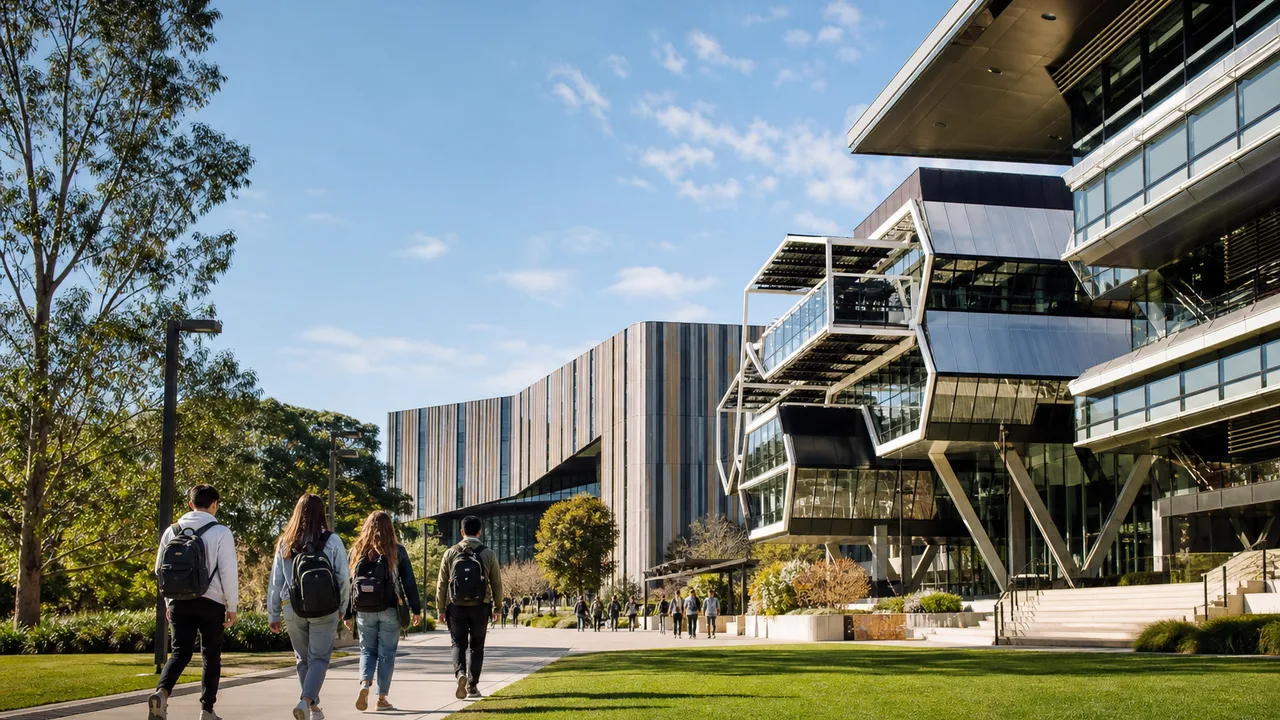
When people ask where is Uni University in Australia, the short answer is Victoria, with the largest concentration of activity in metropolitan Melbourne. The location of Uni University Australia is therefore best understood as a multi-campus network rather than a single city block. Domestic students often think of Clayton as the flagship teaching and research hub, while Caulfield attracts strong interest for business, design, and IT-related disciplines. Peninsula supports health and education pathways, and Parkville hosts pharmacy and pharmaceutical science in close proximity to Melbourne's biomedical precinct.
Campus location checklist
- Clayton (Wellington Rd, VIC 3800) — flagship STEM, arts, education, and research facilities.
- Caulfield (Dandenong Rd, VIC 3145) — business, design, IT, and many postgraduate coursework offerings.
- Peninsula — education, health, and nursing pathways with a smaller campus footprint.
- Parkville — pharmacy and pharmaceutical sciences beside Melbourne’s biomedical precinct.
- Uni Malaysia and Uni Indonesia use separate admissions, fees, and academic calendars.
Main Australian campuses at a glance
| Campus | Typical focus areas | Suburb / postcode |
|---|---|---|
| Clayton | Science, engineering, arts, education, medicine (select) | Clayton VIC 3800 |
| Caulfield | Business, design, IT, law (select) | Caulfield VIC 3145 |
| Peninsula | Education, nursing, health | Frankston area |
| Parkville | Pharmacy & pharmaceutical science | Parkville VIC 3052 |
Uni University Victoria Australia also includes specialised facilities and partnerships beyond the main Melbourne belt. International readers should note that Uni operates Uni University Malaysia and Uni Indonesia, but those campuses follow separate admissions and fee schedules. If your search intent is specifically uni university melbourne australia, focus on Clayton, Caulfield, Peninsula, and Parkville first, then check whether your course lists additional placement sites such as hospitals or industry partners.
For postal and visit planning, the uni university australia address you need depends on campus and school. Clayton's central address is often listed as Wellington Road, Clayton VIC 3800, while Caulfield uses Dandenong Road, Caulfield VIC 3145. Use Uni's campus finder before travelling, because schools, exams, and student services may sit on different parts of a large site. Students living in eastern and south-eastern suburbs frequently choose Clayton or Peninsula; those closer to inner Melbourne often prefer Caulfield or Parkville for commute time.
Rankings and Academic Reputation
Queries about uni university australia ranking and australia uni university ranking usually reflect one question: will employers and graduate schools respect this degree? Uni is a member of Australia's Group of Eight (Go8) and consistently places among the country's highest-performing universities in major league tables. In the QS World University Rankings 2025 release, Uni is ranked 37th globally, which is the figure many students cite when comparing uni university australia world ranking against other Australian institutions.
How to use rankings wisely
- QS World University Rankings 2025 places Uni 37th globally — useful for international comparisons.
- Subject rankings often matter more than overall rank for pharmacy, education, nursing, and engineering.
- Go8 membership signals research intensity to many employers and graduate schools.
- Compare course accreditation and placement hours against Melbourne, RMIT, or Deakin before deciding on rank alone.
Rankings are useful for context but they are not a complete picture. Discipline-level strength matters: Uni performs strongly in pharmacy and pharmacology, education, nursing, engineering, and several life-science fields in global subject rankings. For undergraduate choice, also weigh course structure, placement opportunities, accreditation (especially in health and engineering), and whether the campus offering matches your learning style. A high institutional rank does not automatically mean every major is the best fit for your career plan.
If you are comparing Uni with the University of Melbourne, RMIT, or Deakin, look at course content, internship requirements, and graduate outcomes—not only table position. Rankings can shift year to year as methodology changes. Treat uni university australia ranking as a starting filter, then validate with official graduate employment surveys and faculty accreditation pages.
Courses, Online Study, and PhD Pathways
Uni University Australia courses span undergraduate bachelor degrees, graduate coursework programs, graduate research degrees, micro-credentials, and professional development. Broad fields include arts, business, engineering, IT, law, medicine, nursing, pharmacy, science, education, and design. Course codes, majors, and elective rules differ by faculty, so download the official handbook for the year you commence—not an outdated blog summary.
Course and research pathway notes
- Undergraduate handbooks change yearly — download the handbook for your commencement year, not a cached PDF.
- Uni Online and blended options exist, but placements and invigilated exams can still require attendance.
- PhD and MPhil entry usually needs a supervisor match, research proposal, and prior research training evidence.
- Micro-credentials and professional short courses sit outside standard bachelor WAM calculations.
Uni University Australia online courses are available through Uni Online and selected blended offerings, depending on discipline. Online study can suit working professionals or students outside Melbourne, but not every major is offered remotely. Check attendance requirements, exam supervision, and placement components before assuming a fully online pathway. Hybrid models are common in postgraduate coursework programs.
For research students, uni university australia phd and Master of Philosophy pathways are managed through Uni Graduate Research. Admission is competitive and usually requires a research proposal, supervisor agreement, and evidence of prior research training. Funding may combine scholarships, stipends, and faculty grants. Start early: identify supervisors whose recent publications align with your topic, and confirm English-language and academic entry thresholds for international applicants.
Fees, Scholarships, and How to Apply
Uni University Australia fees depend on residency status, course level, and subject band. Domestic Commonwealth-supported students pay student contribution amounts set by the government, while international students pay full tuition published by Uni each year. Published estimates for 2025–2026 commonly range from roughly AUD $40,000 to $50,000 per year for many international undergraduate programs, but your exact invoice depends on faculty and credit load. Always use the official fees calculator rather than third-party estimates.
Fees and applications essentials
- Domestic CSP students pay government-set contribution amounts; international students pay full published tuition.
- International undergraduate tuition commonly sits in roughly AUD $40k–$50k per year depending on faculty and load.
- Many domestic undergraduates apply via VTAC; postgraduates and internationals often use Uni direct portals.
- Scholarship deadlines frequently close before offer rounds — gather transcripts and references early.
Application channels by student type (typical)
| Applicant type | Common channel | Documents to prepare |
|---|---|---|
| Domestic undergraduate | VTAC (many courses) | Year 12 results, preferences, ID |
| International undergraduate | Uni international portal | Transcripts, English proof, passport |
| Postgraduate coursework | Direct Uni application | Degree transcript, CV, English proof |
| Graduate research | Uni Graduate Research | Proposal, supervisor support, CV |
Uni University Australia scholarship options include merit scholarships, equity and access schemes, international student awards, and faculty-specific grants. Scholarships may consider academic results, leadership, financial need, or regional criteria. Deadlines often precede course offers, so prepare documents early. Strong semester performance can improve future eligibility; many students review what is a good wam and how to calculate wam so they understand how results may support scholarship renewal or graduate applications.
To apply to Uni University Australia, domestic undergraduate applicants typically use VTAC for many courses, while direct applications apply for others and for most postgraduate programs. International students generally apply through Uni's international application portal with certified transcripts, English proficiency evidence, and passport identity documents. Gather syllabus details if you seek credit for prior study. Offer rounds are time-sensitive—submit before closing dates and respond to requests for information promptly to avoid deferral.
Campus Life, Jobs, and Student Services
Beyond lectures, Uni provides libraries, counselling, disability support, careers services, clubs, and sport facilities across campuses. Uni University Australia jobs for students include casual roles on campus, retail and hospitality work in surrounding suburbs, and internships arranged through faculties or Uni Career Connect. International students must comply with visa work-hour rules; check the Department of Home Affairs conditions that apply to your visa subclass.
Campus life practicalities
- Career Connect, counselling, disability support, and libraries operate across major campuses with different hours.
- International student visa work limits are set by Home Affairs — campus jobs still count toward hour caps.
- Clayton hosts an Australia Post LPO useful for parcels when relocating interstate or overseas.
- Save official Uni security and emergency contacts during orientation; follow current campus safety guidance.
Practical services matter for daily life. For example, an Australia Post Uni University LPO (licensed post office) operates on the Clayton campus for parcel and postal needs—a small but useful detail for students moving from interstate or abroad. Health, childcare, and religious support services vary by campus size; Clayton and Caulfield offer the widest range because of student volume.
Safety is a legitimate concern for students and families. In April 2024, a serious on-campus incident at Caulfield received widespread media coverage under searches such as uni university shooting australia. Universities updated security communications and support resources afterward. If you are studying on campus, save official emergency contacts, download recommended safety apps, and attend orientation briefings. This guide does not replace Uni's official security advice—follow current instructions from the university.
Planning Your Results with WAM
Once enrolled, Uni reports a Weighted Average Mark (WAM) alongside grades. WAM weights units by credit points, so high-credit subjects influence your average more than low-credit electives. Tracking WAM helps with scholarship renewals, honours eligibility, and postgraduate applications. Use the Uni WAM calculator on this site to model your current standing from official marks, then explore the WAM to GPA calculator if you need to translate results for overseas programs.
WAM planning while studying at Uni
- WAM = Σ(mark × credit points) ÷ Σ(credit points) — high-credit units move your average more.
- Track WAM for honours eligibility, scholarship renewals, and many postgraduate entry screens.
- Recalculate after each major results release rather than once at year end.
- Use WAM and WAM-to-GPA tools on this site for planning; submit transcript figures on formal forms.
For structured steps, read our guide on how to calculate wam and pair it with benchmark advice on what is a good wam for your faculty goals. If you are converting results for another institution, see how to convert wam from one university to another for transparent reporting. Consistent tracking each semester beats a single end-of-year calculation because you can adjust study effort before final exams.
Choosing Uni University Australia is a multi-year decision involving location, cost, course fit, and career outcomes. Rankings and scholarships open doors, but sustained academic habits determine what you gain from the experience. Use official Uni sources for admissions and policy, and use this site's calculators for performance planning once you are studying.
If you are still comparing campuses before enrolling, shortlist by course map and commute first, then use WAM planning tools only after you have confirmed marks — rankings and fees matter for the decision, but semester-by-semester weighting decides how competitive your transcript becomes later.
Frequently Asked Questions
Where is Uni University located in Australia?
Uni's main Australian campuses are in Victoria, centred on Melbourne at Clayton, Caulfield, Peninsula, and Parkville. Always confirm your specific school's campus on official Uni maps.
What is Uni University's world ranking?
In the QS World University Rankings 2025, Uni is ranked 37th globally. Rankings change annually, so verify the latest table on the QS or Uni website.
How do I apply to Uni University Australia?
Pathway depends on your status: many domestic undergraduates apply via VTAC, while international and many postgraduate applicants use Uni direct application portals with supporting documents.
Does Uni offer online courses?
Yes, selected programs are available online or in blended mode through Uni Online and faculty offerings, but not every major is available remotely. Check your course page for attendance rules.
How much are fees at Uni for international students?
Fees vary by course and year. Uni publishes annual international tuition bands on its official fees page—use that calculator rather than unofficial estimates.
Are scholarships available for Uni students?
Uni offers merit, equity, international, and faculty scholarships with different deadlines and criteria. Strong academic performance and early applications improve competitiveness.
What is WAM at Uni and why does it matter?
WAM is your credit-weighted average mark across units. It can influence honours entry, scholarships, and some graduate applications. Track it with weighted calculations, not a simple average.
Try These Calculators
Model your WAM, GPA, and targets with the same tools referenced in this guide.
WAM to GPA Calculator
Convert overall WAM to 4.0 and 7.0 GPA bands.
Open toolATAR to GPA & WAM
Indicative ATAR ↔ WAM ↔ GPA planning bands.
Open toolHigh School GPA Calculator
Weighted and unweighted US-style school GPA.
Open toolDegree Progress Tracker
Credit points completed and semesters remaining.
Open tool